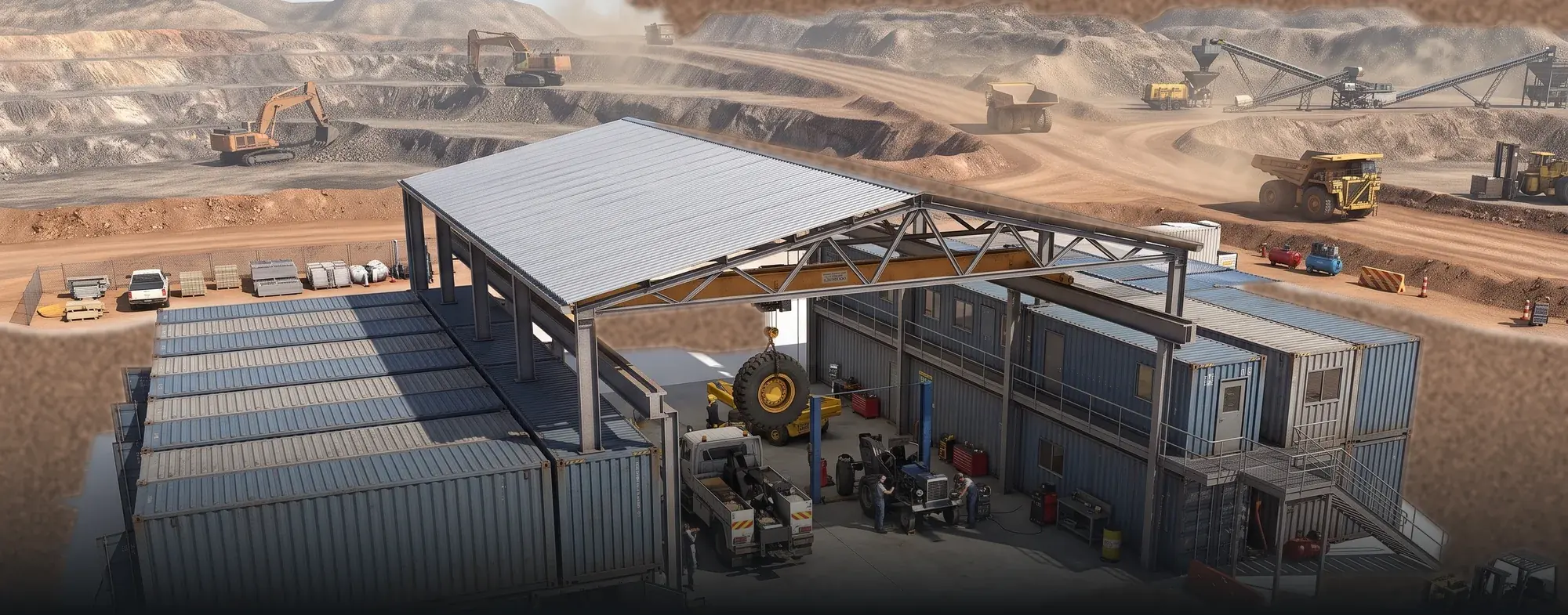
The repair happens behind the counter, not on a truck to town.
A containerised workshop inside your fence line, with crimpers, test benches, exchange stock and a resident technician. High-failure parts are rebuilt within the shift and logged against the machine they came off.
01 / Why repair on site
Downtime is measured in shifts. Repairs should be measured in minutes.
Every component that leaves site for repair takes freight, customs and a spare with it. A resident shop keeps the part, the technician and the record inside the fence.
- Same shift — Hose assemblies built and fitted before the end of shift
- Exchange — Cylinders and pumps swapped from exchange stock, rebuilt behind the counter
- Tagged — Every repair logged by machine, position and cost on WIRE
- 1 team — Store, workshop and technical desk under one contract
02 / What the shop repairs
Pulled from our product catalogue.
These repair and service lines come straight from the Products collection in the CMS.
03 / Inside the shop
A covered bay, an overhead crane and the right fittings on the wall.
Shops are built off site in standard container shells, craned in under a steel canopy and connected on arrival. They grow with the site: start with a hose bay, add a component bench once the failure data shows the need.
- Hose bay — Crimpers, cutters, skiving tools and fittings to OEM part number
- Component bench — Reseal, test and exchange for cylinders and pumps
- Tooling — Overhead crane, compressors, lubrication and filtration carts
- Records — Fitment tags and change-out schedules reported monthly
04 / How a repair flows
From failed part to fitted part, with a record.
- Log the failure — Machine, position and failure mode captured at the counter. — 01
- Rebuild or swap — Rebuilt in the shop, or swapped from exchange stock. — 02
- Fit and test — Fitted by the resident technician and pressure-tested. — 03
- Report — Cost, MTBF and repeat failures reported monthly on WIRE. — 04
05 / Your view
What would you repair on site first?
Scope an onsite hub for your site.
Start with a no-cost consumption and failure survey on your own records. You keep the findings whether or not we proceed.