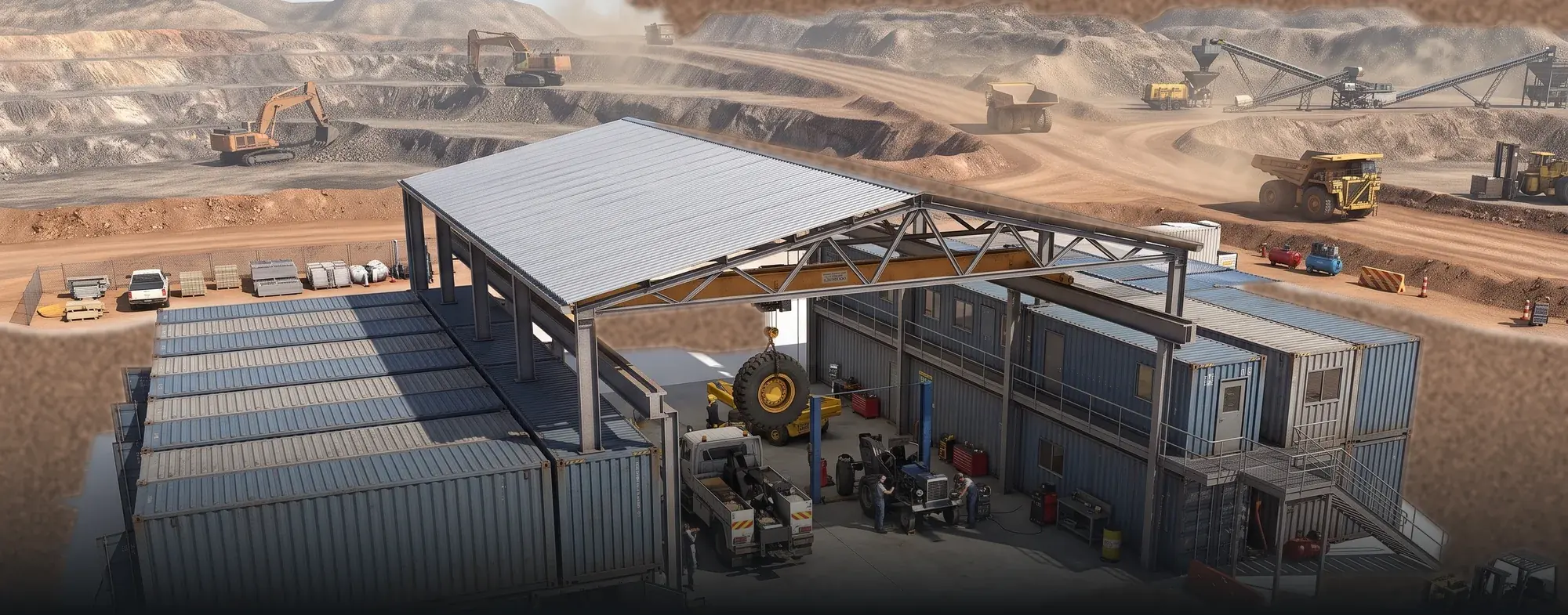
A delivered module, not a construction project.
Containerised consumable stores and repair shops inside your fence line, with inventory held at the critical points of the corridor — replenished to your own consumption data, not a generic stock list.
01 / Why a resident store
A transaction becomes a subscription.
Landlocked sites absorb weeks of freight and customs float on every consumable line. A resident hub converts that float into same-shift response — stock held to your consumption, not to a shipping schedule.
- 3 mth — Rolling stock cover held on site, sized to your survey
- 4 — Layers per hub — store, workshop, VMI, data & technical desk
- 1 — Contract for store, repair and technical support
- Minutes — Response time target, not shifts
02 / Why it matters
Downtime is decided by where the part is.
- Uptime — The technician, fittings and crimper are already inside the fence — response in minutes, not shifts.
- Lower total cost — Freight, expediting and emergency buying fall away, leaving only the part and labour.
- Lean inventory — Stock held to consumption, not lead time, releasing working capital that was sitting idle.
- One accountable team — A single agreement and technical team, with no triage between vendors when something fails.
03 / Look & feel
Built off site. Craned in. Branded to the site.
Every module is a standard container shell, fitted out to a consistent Omni AltAmana finish — charcoal shell, safety-orange detailing and clear wayfinding — so crews know the store, the workshop and the technical desk on sight.
- assets/workshop-scene.webp — Full onsite hub — stores, covered workshop bay and two-storey technical desk
- assets/store-panels.webp — Concept render — hose & fittings store layouts — light
- assets/container-canopy.webp — Concept render — store module with canopy and loading deck — light
- assets/container-cage.webp — Concept render — secure VMI cage with mesh racking — light
- assets/technical-desk.webp — Concept render — technical desk and data module — light
- assets/module-deck.webp — Concept render — office module with timber deck — light
- assets/brand-vehicle.webp — Fleet branding — Omni AltAmana service vehicle
- assets/brand-helmet-copper.webp — Branded PPE for resident crews
04 / Four layers, one contract
Split the same way your maintenance team is.
- 12 m store — 5-tier racking, trade counter and hose bay. — 01 / STORE
- 6 m workshop — Repairs behind the counter instead of shipped out. — 02 / WORKSHOP
- 6 m VMI unit — Vendor-managed MRO stock, owned by the hub until consumed. — 03 / VMI
- 12 m technical desk — Every withdrawal tied to asset and cost on WIRE. — 04 / DATA
From port to pit
Inventory buffered at every point that decides lead time.
Bonded port stock, inland hub warehouses and resident site stores — so the part is already in the corridor when the plant calls for it.
- assets/corridor-port.webp — Port of entry — consumables landed, bonded and cleared
- assets/container-truck.webp — Containerised consumables moving inland by road
- assets/corridor-highway.webp — Corridor freight to the inland hubs
- assets/container-branded.webp — Store module inside the fence
- assets/warehouse-drums.webp — Hub warehouse — lubricants and reagents
- assets/warehouse-forklift.webp — Inland hub stock, palletised and tracked
05 / Inventory at critical locations
Consumable stores and repair shops where they count.
Stock is buffered at every point that decides lead time: the port of entry, the inland hub and the store inside the fence. Each location reports on-hand, min/max and ageing to WIRE.
06 / Three configurations
Three configurations, each one upgradeable.
Each option upgrades to the next by craning in further modules.
- Option A — Store first — One 12 m store module with trade counter and hose bay. Ideal for a first trial on one circuit or fleet. — A
- Option B — Store & repair shop — Store plus 6 m workshop and VMI units — repairs and vendor-managed stock on site. — B
- Option C — Onsite innovation hub — Two 12 m and three 6 m modules, with technical desk, welfare and partner bays. — C
07 / The modules
Hub modules and units.
08 / How we get the fit right
Data first, product second.
- Consumption survey — Usage, wear and failure data read against your plant, at our cost. — 01
- Hub scoping — Modules, footprint, headcount and stock sized to your survey. — 02
- Supervised trial — One circuit or fleet, measured against your baseline. — 03
- Contract & commission — Terms and cost-per-tonne reporting agreed before the module is craned in. — 04
09 / Your view
Where would buffer stock help you most?
10 / The network in detail
Every location, its role and what it holds.
| Location | Country | Role |
|---|---|---|
| Durban | South Africa | Port of entry |
| Dar es Salaam | Tanzania | Port of entry |
| Ndola | Zambia | Strategic hub |
| Kolwezi | DR Congo | Strategic hub |
| On the mine | Copperbelt · Katanga | Mine site store |
| Kitwe | Zambia | Office |
| Johannesburg | South Africa | Office |
| Solwezi | Zambia | Mine site store & repair shop |
| Kitwe | Zambia | Mine site store & repair shop |
| Lubumbashi | DR Congo | Mine site store & repair shop |
| Kolwezi | DR Congo | Mine site store & repair shop |
Ready to scope a hub for your site?
Start with a no-cost consumption survey — findings are yours either way.